
How much do veneers cost and what is included in that price
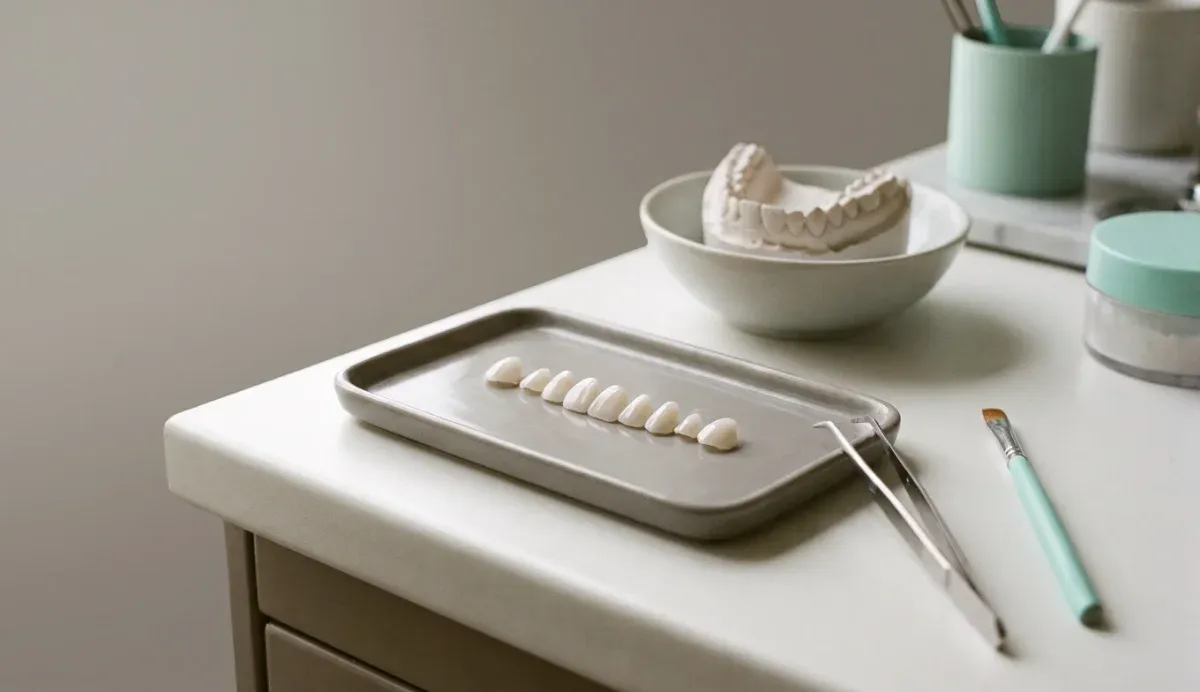
Four things drive the cost of veneers: the material, the number of teeth, the condition of your mouth and the country of treatment. That is why two quotes for the same number of teeth can differ by 3–5 times. Below are realistic price ranges and an explanation of what you actually pay for.
Veneer material costs
The material is the main price driver. Composite is cheaper but lasts half as long; E-max costs more yet pays off with a 15–20 year lifespan.
According to scientific reviews, the gold standard for veneers remains pressed ceramic (lithium disilicate, E-max) — it offers the best translucency and the thinnest enamel preparation. For patients with bruxism (teeth grinding), high-translucency monolithic zirconia is used more and more, while the newest direction is hybrid restorations (lithium disilicate over a zirconia framework) that combine strength with a natural look.
| Material | Price per tooth | Lifespan | Key traits |
|---|---|---|---|
| Composite | €150–400 | 4–7 years | Cheapest, placed in one visit, darken over time |
| Ceramic (porcelain) | €400–900 | 10–15 years | Natural look, colour-stable |
| E-max (pressed ceramic) | €500–1000 | 15–20 years | Strongest and most aesthetic |
Start with a match, not a random list of clinics
Answer a few questions and see which factors matter for your case
Veneer prices by country
The price of identical veneers depends heavily on the country of treatment — and the gap comes from economics, not material quality. In Türkiye or Hungary, taxes, rent and labour cost less, so clinics deliver the same (often higher) level of service for less. In France or Germany the same veneers cost several times more, mostly because of high clinic overheads rather than a better result. So a more affordable country can even offer better care.
| Country | Price per tooth | Why this price |
|---|---|---|
| Türkiye | €200–350 | Lower taxes and labour costs at comparable quality |
| Hungary, Poland | €300–550 | Mid-range EU prices, closer for Western patients |
| France, Germany | €800–1500 | High rent, labour and insurance costs |
| USA | €900–2500 | The highest clinic overheads |
- Treatment & materials
- Hotel nights
- Transfers
- Coordinator-translator
Factors that affect the cost
Even within one clinic the total can differ between two patients. A good dentist always starts from an individual approach: the goal is to restore function and aesthetics while preserving as much of the patient's own tissue as possible. Healthy teeth are not ground down if the result can be achieved more simply — with whitening, for example. Long-term health comes before a quick cosmetic effect. Here is what shifts the price the most:
- Number of teeth. Most often 8–10 veneers on the upper jaw (the smile zone) or 16–20 for a full set.
- Amount of preparation. Minimal enamel reduction costs less; a damaged tooth that needs an inlay or correction costs more.
- Dental condition. Cavities, root canal or gum treatment are done before the veneers and billed separately.
- In-house lab. Clinics with their own dental laboratory make veneers faster and control colour and shape more precisely.
- Dentist's experience. Clinicians with international practice and a portfolio of cases usually charge more.
How the final treatment estimate is formed
The exact price is only set in person. From a photo the dentist can estimate only the approximate scope; the real condition is visible in the chair, sometimes only during the procedure: after removing an old crown, for instance, the dentist sees the true colour of the canal and decides whether extra work is needed (internal canal bleaching or gum correction) so the tooth does not look dark near the gum line. In aesthetics this is fine, jeweller-like work that requires assessment and attention right at the appointment.
The overall patient journey — from the first consultation, where the price is confirmed, to the follow-up check — looks like this:
- 1Consultation
Examination, discussion of your goal and risks, treatment scenarios and a price for each of them.
- 2Scanning
Digital scan or impressions for a precise mock-up.
- 3Smile Design
Designing the shape and colour of your future smile.
- 4Preparation
Minimal enamel reduction and lab fabrication of the veneers.
- 5Bonding
Try-in, bonding of the finished veneers and bite adjustment.
- 6Follow-up
Follow-up check and aftercare recommendations.
That is exactly where Medikout helps: we compare clinic offers against your criteria — you see the prices side by side, understand what each package includes and choose the option that fits your budget, instead of collecting data from dozens of websites.
Start with a match, not a random list of clinics
Answer a few questions and see which factors matter for your case
References
- Aydoğdu H.M. et al. Comparison of translucency of monolithic zirconia and lithium disilicate for veneers. Heliyon, 2024.
- Cesar P.F. et al. Recent Advances in Dental Zirconia: 15 Years of Material and Processing Evolution. Dental Materials, 2024;40:824–836.
- Comparison of long-term clinical outcomes of zirconia and lithium disilicate restorations. Biomimetics, 2025;10(11):740.